
|
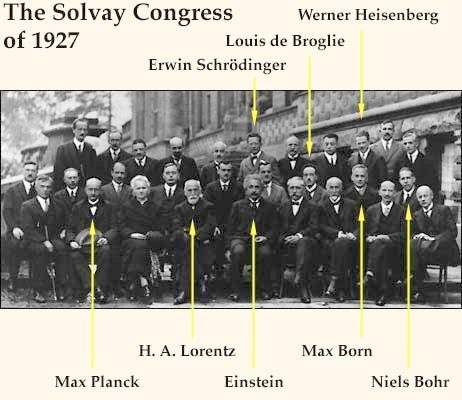
A few years ago I thought that everyone knew what physics is, however my assumption was wrong. When I graduated from high school, people asked me what I was going to major in when I started college and I told them "physics!" To my astonishment, there were many people who did not know what physics is! So.....for all of the people out there who don't know what physics is, here is a dictionary definion: Phys·ics (fiz'iks) The science that deals with matter, energy, motion and force. That is a very basic and limited definition. What physics really is, is the mathematical study of the fundamental laws of the universe. For many centuries it was not called physics, it was referred to as "natural philosophy" and the people who practiced it were referred to as "philosophers" or "natural philosophers" (Aristotle, Archimedes, etc.) Physics is truly the "mother of all sciences" because it is the most fundamental of all fields of science. It is also possibly the most difficult science to understand because it requires a broad knowledge base, highly abstract thought, and an ability to think mathematically and visually. Even though physicists have been studying the laws of nature for centuries, we still don't truly understand the basis for most of the laws, but we are slowly advancing in our understanding. Successful physicists are often regarded as some of the most intelligent people in the world. Some examples: Isaac Newton, Albert Einstein, and Stephen Hawking. This is why we say "Einstein" when we mean "genius" or "smart" Example 1: "He's no Einstein" means that a person is not a genius. Example 2: "it doesn't take a rocket scientist to figure that out" means that it doesn't take a genius to figure that out. You can find out much more information about physics at the American Institute of Physics. The following is a physics problem I made up so that you can get a glimpse of what physics looks like. AHH...Triple Integration!! Let's find the mass of the solid bounded above by z = (x2 + y2)1/2 and below by z = x2 + y2 with density proportional to the distance above the xy plane! Here we go.... first of all, the upper surface z = (x2 + y2)1/2 is a cone and the equation can be written in cylindrical coordinates as z = |r|. You may also notice that the lower surface z = x2 + y2 is a paraboloid and can be written as z = r2 in cylindrical coordinates. Changing the coordinate system will make the integral simpler to evaluate. The fact that the density is proportional
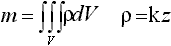
to the distance above the xy plane means that the density, in
symbols:
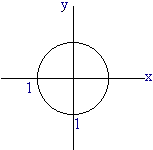
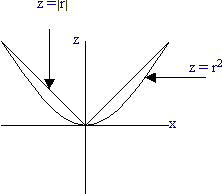
In order to find the appropriate limits of integration we must get an idea of what this solid looks like by sketching it. In the xy plane the two surfaces intersect at the origin. The surfaces intersect once again in the plane z=1. In this plane the surfaces intersect in a circle of radius one.
In the xz plane and the yz plane the intersection of the two surfaces looks like this:
By looking at these graphs we can find the limits of
integration. The limits of integration on and so the final integral
is: Now the integral is ready to be evaluated!
Finally we see that the mass
is 1/12 |
Some Links
| American
Institute of Physics Stephen Hawking MC Hawking |
JMU
Physics Department JMU Physics Majors Journal of Theoretical Physics |
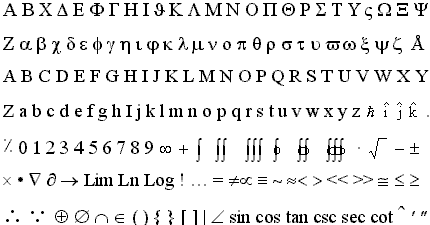
Some of the many symbols that we frequently use
 ,
is z multiplied by a proportionality constant k. In symbols:
,
is z multiplied by a proportionality constant k. In symbols:
 are [0, 2
 ]. The
limits of integration on r are [0,1]. And the limits on z are [r2,r]
]. The
limits of integration on r are [0,1]. And the limits on z are [r2,r]